
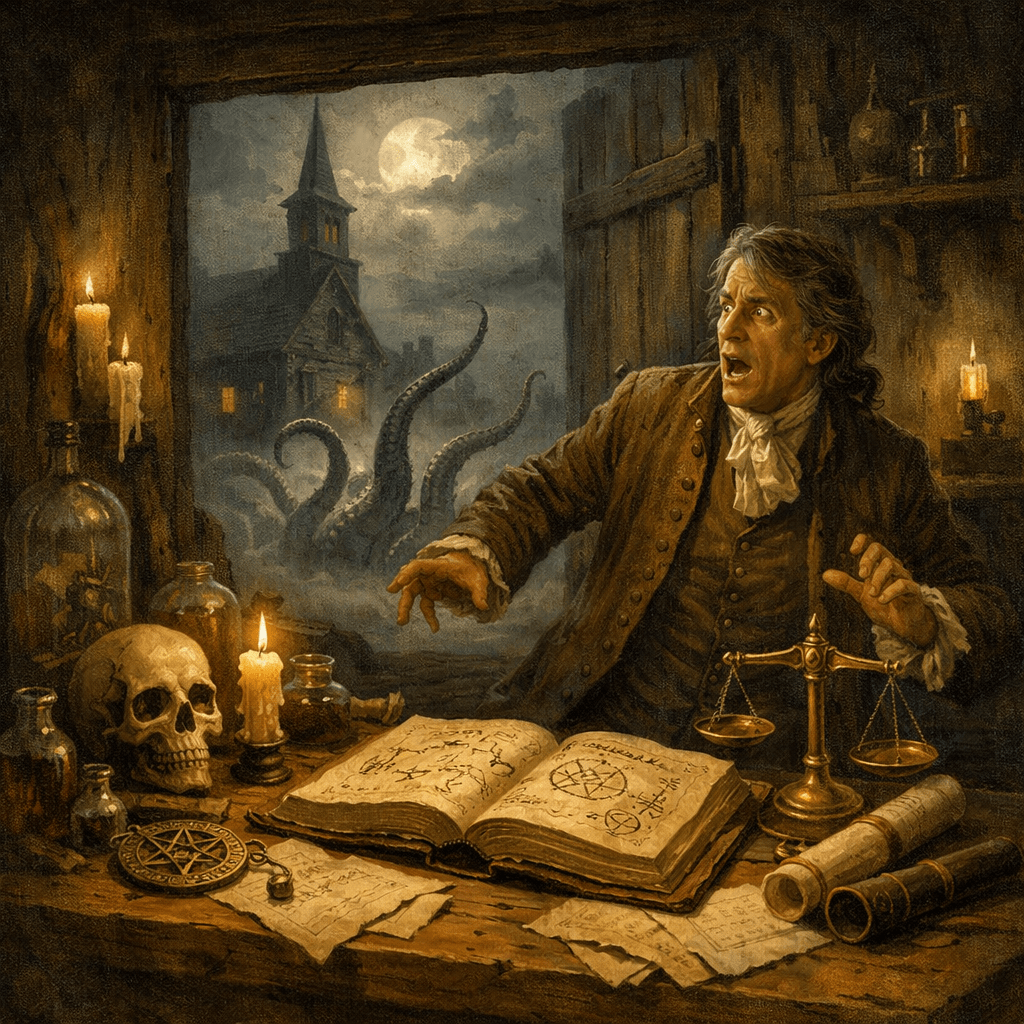
Overview
This project explores the intersection of early American natural philosophy, Enlightenment rationalism, and cosmic horror. It imagines a setting where the optimism of a knowable universe collides with the indifference of the unknowable — a uniquely American frontier of reason and dread.
Concept
The Colonial‑American Call of Cthulhu setting reinterprets Lovecraftian horror through the lens of the 18th century. Here, the mythos emerges not in industrial shadows but in candlelit laboratories, apothecaries, and philosophical societies. The Age of Reason becomes the stage for the collapse of reason itself.
Themes
- Enlightenment vs. the Unknowable
- Natural Philosophy and the Limits of Observation
- Colonial Expansion and Cosmic Indifference
- Faith, Science, and the Fragility of Understanding
- The American Frontier as a metaphysical boundary
Development Notes
This page will grow as research deepens — historical references, mythos reinterpretations, and play materials will be added over time. Early sketches include:
- Setting Framework: 13 Colonies, 1720–1790
- Tone: Rational inquiry dissolving into existential dread
- Influences: Franklin’s experiments, Cotton Mather’s theology, Jefferson’s curiosity, Lovecraft’s cosmicism
Future Additions
- Character archetypes drawn from colonial professions and philosophies
- Mythos entities reimagined through Enlightenment metaphors
- Historical timelines and key events
- Play scenarios and narrative seeds
Closing Thought
This project is a study in progress, not a finished work. It seeks to understand how the American Enlightenment — a moment of profound confidence in human reason — might unravel when faced with truths beyond comprehension.
“The pursuit of knowledge is the most dangerous of all human endeavors.”
 The American Natural Philosopher